Saturday, June 6, 2015

Switzerland

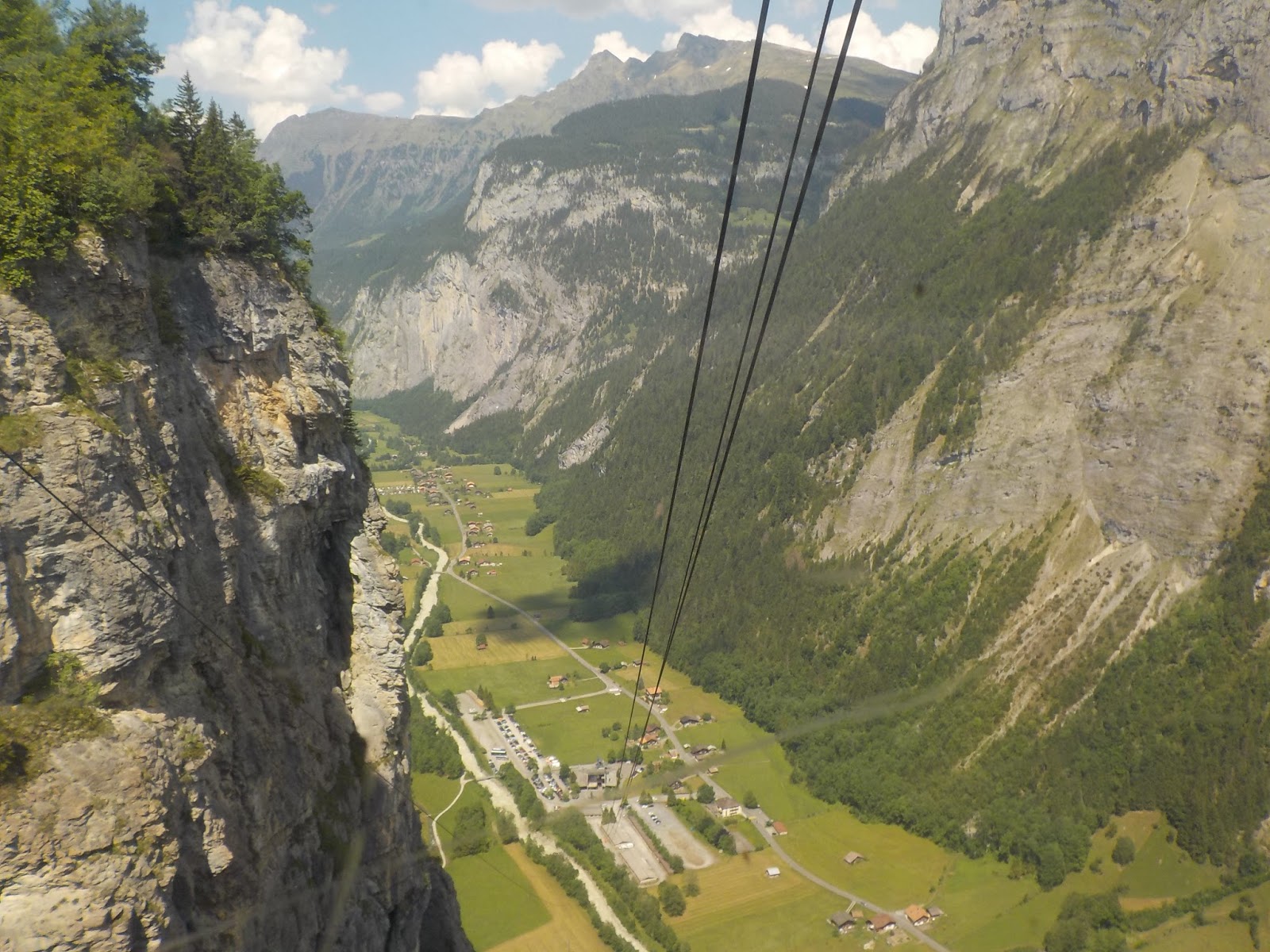
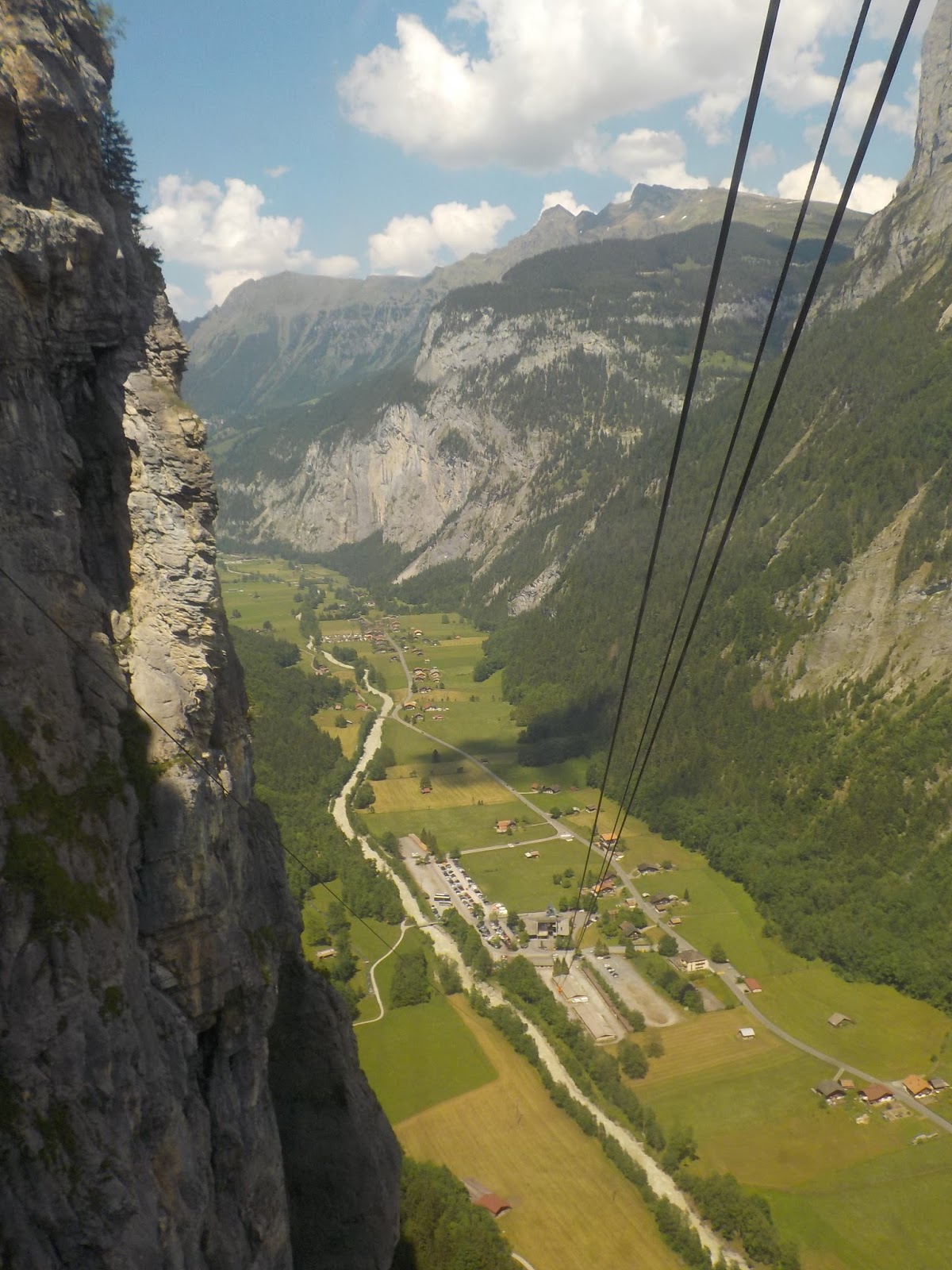
I had been looking forward to the clear mountain air of Switzerland for months. It is more than a breath of fresh air, I think it may be the most beautiful place I have ever been. It is like 5x better than Yosemite combined with the Canadian Rockies. Everywhere you turn is a picture post card. I couldn't count how many 100+-foot waterfalls I saw today.

The steep pastures look so verdant, I almost wish I were a cow. This must be cow paradise. The milk here has got to taste better. The cows and goats all wear bells, I'm guessing so they can be located.

We are staying at a hostel in Interlaken nestled between Lake Thun and Lake Brienze.

We visited the small village of Gimmelwald via train, bus and gondola. From there we hiked 2 miles up (1,000 feet) through alpine meadows to the village of Murren for biers and milkshakes and then back down to the Gimmelwald. Gimmelwald has 120 residents and appears to be a working town. Everyone had wood laid in and many were working to bring in hay from very steep slopes. They use unimogs, ingenious articulated vehicles, to transport goods including hay. Murren is at 5,400 feet elevation and has a population of 540.

This is the first place we've been on this trip where people really have to deal with winter. The thought and effort required really shows.

Lake Brienze from the train

Interlaken from Harder Kulm

Interlaken from Harder Kulm

Interlaken from Harder Kulm

Interlaken from Harder Kulm

Interlaken from Harder Kulm

Harder Kulm


Harder Kulm

Harder Kulm

Harder Kulm
 

Gimmelwald

Gimmelwald

Gimmelwald


Wild flowers are everywhere


The view from our picnic lunch (included fresh Swiss cheese and Swiss strawberries and raspberries)


View of Jungfrau, the valley's dominating mountain

The Eiger from Murren

The Eiger from Murren

The Eiger from Murren

The Eiger and Jungfrau from Murren


The gondola down


A waterfall from the valley floor

A river white with glacial floque (rock flour)
 
The view from my bunk in our hostel 


Como

We stayed night in Como in northern Italy, a beautiful small town an a very long lake. We wanted to travel through Switzerland by day for the views. We took another funicolare and  ate some excellent gelato. The kids are averaging more than one ice cream/gelato per day on this trip. Como was the first place we have stayed in Europe that was not a tourist mecca. Next trip we will visit natural features and skip cities and tourist destinations.

e


Thursday, June 4, 2015

Venice (Venezia)

We visited the Da Vinci Museum in the morning before leaving Florence. It was full of reproductions of  Da Vinci's paintings and machines. Leonardo was the quintessential renaissance man. With a day job as a painter (Mona Lisa, Last Supper, etc.), he still had time to be a leading engineer, architect, anatomist, physiologist, mechanic and armorer. Interesting stuff.
 
Da Vinci bicycle
 
We left Florence for Venice via train. For the first half hour we traveled through tunnels under the Apennine Mountains seeing sunlight maybe six times for a total of 30 seconds. We emerged from the tunnels about 100 kilometers from Florence, just short of Bologna.  The rest of the way to Venice, we crossed the Po River valley which was extremely flat and planted in wheat, corn, hay and what looked like soybeans and alfalfa. It looked a lot like the American Midwest, but the fields were somewhat smaller and all of the farm houses had red tile roofs (by my measure 98% of all buildings have red tile roofs in Italy).
Venice is an island-city accessed via a miles long causeway located in the middle of a lagoon. It is really 100+ islands separated by canals and connected by 400 bridges. Venice is a maze of more than 2,000 alleys, many of which are dead ends and some no more than 3-feet wide or 5-feet high. We found Google Maps to be unreliable, but alleys were well marked.
There are no automobiles in the city (the causeway road ends in a large parking lot).  Everything on the island pretty much comes and goes (rubbish) via boats and hand trucks. The copier repair man comes in a boat full of copiers. I saw a boat just full toilet paper which I never quite figured out how left the city (there were few foul smells in Venice).
The population of Venice is now 58,000 (down from 170,000 sometime late in last century). However, on an average day, there are 55,000 tourists in Venice. As a result, Venice seems to have an identity crisis. It is a tourist town with the feel just short of a theme park. The alleys are lined with shops, 90+% of which sell glassware, t-shirts, leather goods, masks, gelato, pizza/panini or some combination of the above.
We had a fantastic apartment in the San Polo neighborhood in the center of the city. It was the quietest and most comfortable place we stayed since the boat on the Nile. I got 8 hours sleep last night. I can’t remember the last time that happened.
We took it pretty easy in Venice, choosing to not go anywhere that required standing in a line. Walking the alleys and crossing the canals was an experience in itself. We did take a Vaporetto boat tour of the Grand Canal and also visited the island of Murano, known for glass work. The glass industry was moved to Murano to reduce the risk of fire on the main islands of Venice.  As we walked the back alleys of Murano, we could hear the roar of furnaces and look in to see work being done. It seemed more like a real community and less like a theme park.
Venice is slowly sinking. Several buildings lean in awkward directions. The wooden pilings on which the city is built are slowly decaying. As the stone foundations settle and sea levels rise, marine waters reach the brickwork above the foundations causing it to further rot. We witnessed a piling break off and fall on the boat that had been moored to it. In flood-prone areas, the doorways have been fitted with flood gates. The whole lagoon is close to being flood-proofed. Four huge (1,200 to 1,500-foot long) flood gates are being constructed across the ship canals between the barrier islands separating the lagoon from the Adriatic Sea. The gates are hinged at the seafloor and when inflated will rise above the flood tides. This may work for a while, but if sea levels rise even a foot, the gates will only be able to be opened at low tides.
Venice has been around for more than 1,500 years.  Almost all of the livable area was raised from the lagoon marshes. For most of its existence, its only source of drinking water was rainfall. An elaborate system of drains, sand filters and cisterns was constructed to solve the problem. The cisterns were unlocked by magistrates and opened only twice a day.
Typical Venice canal


On the way from the train station to our apartment

The Rialto Bridge - the largest of three bridges that cross the Grand Canal

A gondola on the Grand Canal– romantic and provide great ambiance, but really expensive.

Typical gondola prow

Basilica di San Marco

Basilica di Santa Maria della Salute

Basilica di San Marco

Campanile di San Marco

A Venice canal
 
Flood door

A cistern formerly used for the water supply

Grand Canal

A boat being unloaded onto a hand truck

Mask shop in the City of Masks

A canal on the Island of Murano

Island of Murano

Island of Murano

Glass Museum on Island of Murano


Monday, June 1, 2015

Florence (Firenze)

We caught another high speed train, this time from Rome to Florence. It is pretty amazing when you can travel 280 km (168 miles) door to door in less than 3 hours using only public transportation (and you feet of course).  I'll note here that for 3 months, we have each been living out of a single carry-on sized bag.

The trip crossed a good part of Tuscany which was impressive. I wish we had a car and more time, but I'll save that for a future trip sans kids. The Tuscan countryside appears neat and orderly with rolling hills covered with small plots and relatively few straight lines. The result is a more organic feel than the large mono-culture crops we see at home. There are orchards, vineyards, pastures and wheat near ready to harvest.

Florence is compact leaving little need for public (or other) transport. Although, there are little buses that manage the narrow streets. Other than that there is surprisingly little vehicle traffic in "downtown" Florence. I thought Rome was busy with tourists on a Saturday; Florence matches that on a Monday. Everyone is stopping and pointing and gawking and posing and taking photos. I'm right there with them, but my stride doesn't seem to match the rest of the crowd's.

There were not many bicycles in Naples. There were more in Rome, but it was a weekend so they were mainly recreational. Watching people ride on the cobblestones made my butt and teeth hurt. There are plenty of bicycles in Florence, but the streets are paved with paving stones (minimum 12" x 12") so the streets are smoother.

Ann-Kristin booked a 2 bedroom apartment overlooking the Piazza del Duomo, a pretty popular place. We look out on hundreds (at times maybe more than a thousand) tourists and up at the immense Cathedral di Santa Maria del Fiore. There is no sleeping past 7:00 am when the bells ring.

In addition to just wandering around (we've covered 10 miles in a two part days), we were able to visit the Galileo Museum, the Uffizi Gallery, the Accademia Gallery and climb to the Piazzale Michelangelo for a view of the city. The Galileo Museum displays lots of telescopes, astronomical instruments, and mechanical and electrical experimental devices. The Uffizi Gallery is the "greatest collection of Italian paintings anywhere." The House of Medici initiated the art collection in 1560 (47 years before Jamestown). It includes works by Bottecelli, DaVinci, Michelangelo, Perugino and Rafael to drop a few names. Bottecelli has a way with complexions, but not feet. DaVinci had an almost grotesque understanding of human anatomy and Michelangelo's works were just simply beautiful. The Accedemia Gallery is dedicated to religious art mostly from the Renaissance. It is home to Michelangelo's David and several unfinished works. David is carved from an enormous (17 feet) and remarkably unblemished hunk of marble. David's face looks pretty tense, like someone about to face a giant with only a sling. He's got great hair though. There are also several of Michelangelo's half-finished sculptures that are nearly as interesting and help one understand how figures take form out raw marble.

We hope to go to the DaVinci Museum tomorrow.

We try to research what we should be doing a day or two ahead. It takes a lot of effort, especially since getting to Europe where there is such a density of things to see and our schedule is compressed. When we looked at Florence, things did not seem promising. The two main attractions, the Uffizi Gallery and the Accademia Gallery are closed on Mondays, the one full day we had in Florence. All the websites we checked said we should have booked well in advance of traveling to Italy. We tried and couldn't find tickets online for the partial days we were there. To be sure, we stopped by the Uffizi and checked on Sunday and the lines were a block long for both ticket purchase and entry to the museum. We decided to write both galleries off.  Then Sunday night Ann-Kristin checked online again and found they were selling tickets for Monday, June 1st. Go figure?  It turns out June 1 was to be a "straordanaria" day and both the Uffizi and Accademia would be open. I bought tickets online and when we went to the Accademia in the morning there was virtually no one there. Everyone seemed to have the same expectations we had that the galleries were closed and so no one showed up. No lines whatsoever and very light attendance inside. We had the same experience in the afternoon at the Uffizi. Double bonus! Like on most all of this trip, we have been most fortunate in Florence.

 An Italian Frecciarossa bullet train

What it looks like to go 180 mph!

Cathedral di Santa Maria del Fiore from the front door  of  our  apartment

Galileo Museum telescopes

Ponte Vecchio (a bridge lined with shops) - the only bridge across the Arno to survive the Nazis

Florence street

Zoe and Jack eating meringues

East Florence from Piazzale Michelangelo

Florence from Piazzale Michelangelo

Jack and Zoe chasing bubbles

The sun setting behind Ponte Vecchio over the River Arno
 Palazzo Vecchio

Michelangelo's David at Accademia Gallery

Piazza del Duomo from our apartment

Cellini's Perseus with the Head of Medusa at Piazza della Signoria
 Botticelli's The Birth of Venus

Botticelli's Spring

Ponte Vecchio

Michelangelo's Holy Family with the Infant St. John the Baptist

A Florentine mini-bus